
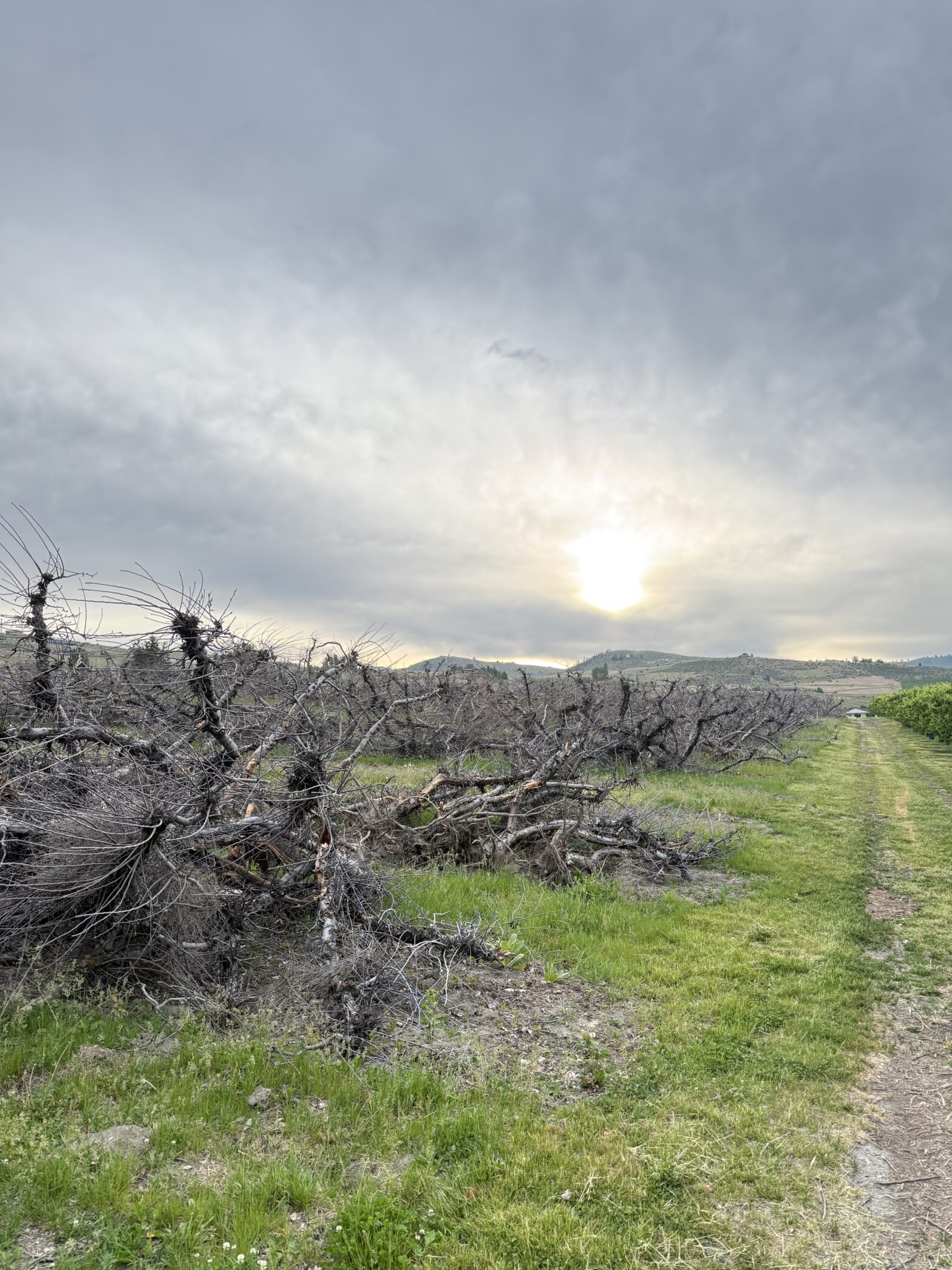
On a drive to the gym this week, I passed a 20-acre orchard laying on its side — and the question hit me harder than I expected. Here’s where it took me. by Chad
On the way to the gym one morning this week, I drove past a 20-acre orchard laying on its side. Trees freshly pulled. All of them dead, on the ground. Decades of life and work — done.
A family used to be able to make a living from an orchard that size. These orchards have histories going back to the early 1900s. And I sat there in the truck thinking, metaphorically, about Agriculture right now and what it means to be a first-generation farmer and small business owner.
Agriculture across the U.S. is hurting. Prices are depressed (and remember — farmers are mostly price takers). Inputs are high. Labor costs are high. Farmers are tough, and right now is when their resolve gets tested.
It got me thinking — are we going to make it?
Will farmers make it through this stretch? Isn’t this a question we all ask in different parts of our life? It runs through my mind plenty as a first-generation farmer and small business owner, with a new job. Not because we’re failing — we’re not. Because we’re paying attention.
The question is — what can we do?
As a consumer, I keep saying it: know your farmer.
As a farmer, I’d ask: how can I add more value? What’s actually in my control?
Which leads to the why.
For small business, the math is brutal — most are gone by year ten. I get it. It wears you out if you don’t have a strong why.
Our why is in our mission: connecting families to farming.
Farmers’ why? Is it strong enough to pull them through? Local growers I’ve met and become friends with say things like, “I remember Grandpa and my uncle having to go get jobs,” or “I want to keep taking care of my trees and my land.” I think a lot of farmers’ why is deep and rooted in the land — rooted in their history and their legacy, caring for the ground their family has worked for generations.
The reality of agriculture right now? My crystal ball says we’re going to see consolidation. Farms getting bigger. Or farms getting more focused on selling direct to their customers — maybe better suited for small growers like us.
What does this mean for you?
I think you should care most about what this all means for your food and your wine.
As we move toward Mother’s Day, we can also celebrate Mother Earth — and how caring for her can help our farms and our businesses. If there were ever a time to consider doing things differently, farming differently, now is the time. Fully recognizing that change in the middle of a crisis can be scary as hell.
When I think of Mother Earth, I think of soil. Protecting and investing in soil is how we care for Mother Earth. Honestly, there’s no better Mother’s Day gift we can give her.
And there are a hundred ways to do it. Sheep in the vineyard. Cover crops between the rows. Less tillage. Compost. Feeding the biology in the ground instead of just feeding the plant. Places like the Rodale Institute have been training first-generation farmers in this approach for decades: Every grower has something they can do, and a lot of growers are already doing it. That’s the part that gives me hope.
Healthy soil grows food with more flavor, more nutrients, more of what’s supposed to be there. It’s not magic — it’s biology. The plant pulls what it can from what’s around it. If the soil is alive, the food and the wine reflect that. If the dirt is dead, so is everything that comes out of it.
That’s the bet we’re making. Not because it’s trendy. Because we’ve seen it work.
And still — knowing all that, choosing to keep going still costs something.
Is it scary and gut-wrenching and heartbreaking and tough? F#*! yes it is. A dead orchard. A history and a way of life — gone.
But — hell yes, we’re going to make it.
This could be one of the most exciting times for farming, for Mother Earth, and for our food. The move toward soil and regenerative farming is a food and farmer revolution. Imagine — food that tastes better and is better for you. Wine that tastes better and is better for you.
And here’s another why: if this soil revolution plays out, we’re supporting a farming system that makes our soil, our farms, and nature healthier for the next generation. That’s a hell of a why. That’s legacy.
Farming — it’s tough right now. The why is strong. Farmers’ resolve is strong.
Come celebrate the moms in your life this Sunday at a place that’s pouring itself into caring for Mother Earth.
Cheers!
I love your honesty and openness. It’s so refreshing to read your blogs about what is really important to all of us both locally and globally. Your families optimism, hard work and dedication is very admirable! Thanks Chad!
Thank you a ton!!! Love this. Really appreciate the note. I somewhat feel a bit of a second guessing going on in my writing… part of it is migrating over the last 4 years doing this from these super long technical pieces to more experience and story driven writing with learning webbed in. Thanks for taking the time to comment.
What a beautiful thing you and your family are doing! We are privileged to hear your story and how it is changing and growing.
Soo appreciate you taking time to write this note. It keeps me going. We love what we’ve been building – and in “we” i include you guys as well. Tahnk you for the support!!
Heck yeah brother. You are on the right track. Some revolutionary discoveries in agriculture happening. And you’re one of the first leaders/ adopters. Scary and exciting all at the same time.
I learned from you! Without you i wouldn’t have gotten such a strong start and had such a good friend all these years. It is damn exciting… really amazing opportunity
Great thoughts, Tara and I often wonder and talk about this as we drive around and see what we call the “orchard graveyards”. In my opinion, people need to be more and more aware of the impact of the increasing US reliance on exported food. The American Economic Liberties Project (AELP) has done some really interesting studies on this. We seem to have a history of outsourcing critical components of our economy (rare minerals, ship building, etc, etc) then waking up years later and figuring out it’s not a great policy to rely on other countries for critical economic components. I worry we are going to wake up 5-10 years from now and figure out we made the same mistake with agriculture. For now we have to all stay educated on the big picture and support local whenever possible.
Amazing Stephen. I love the thoughts and thought you’ve given it, of course b/c you’re farming too. I think the biggest foundation of it all is capitalism. But it’s left us all so hungry to keep our connection to the land. To preserve a way of life. Public policy still has an opportunity to make an impact… but the rate at which we’re losing farmers is surprising…