
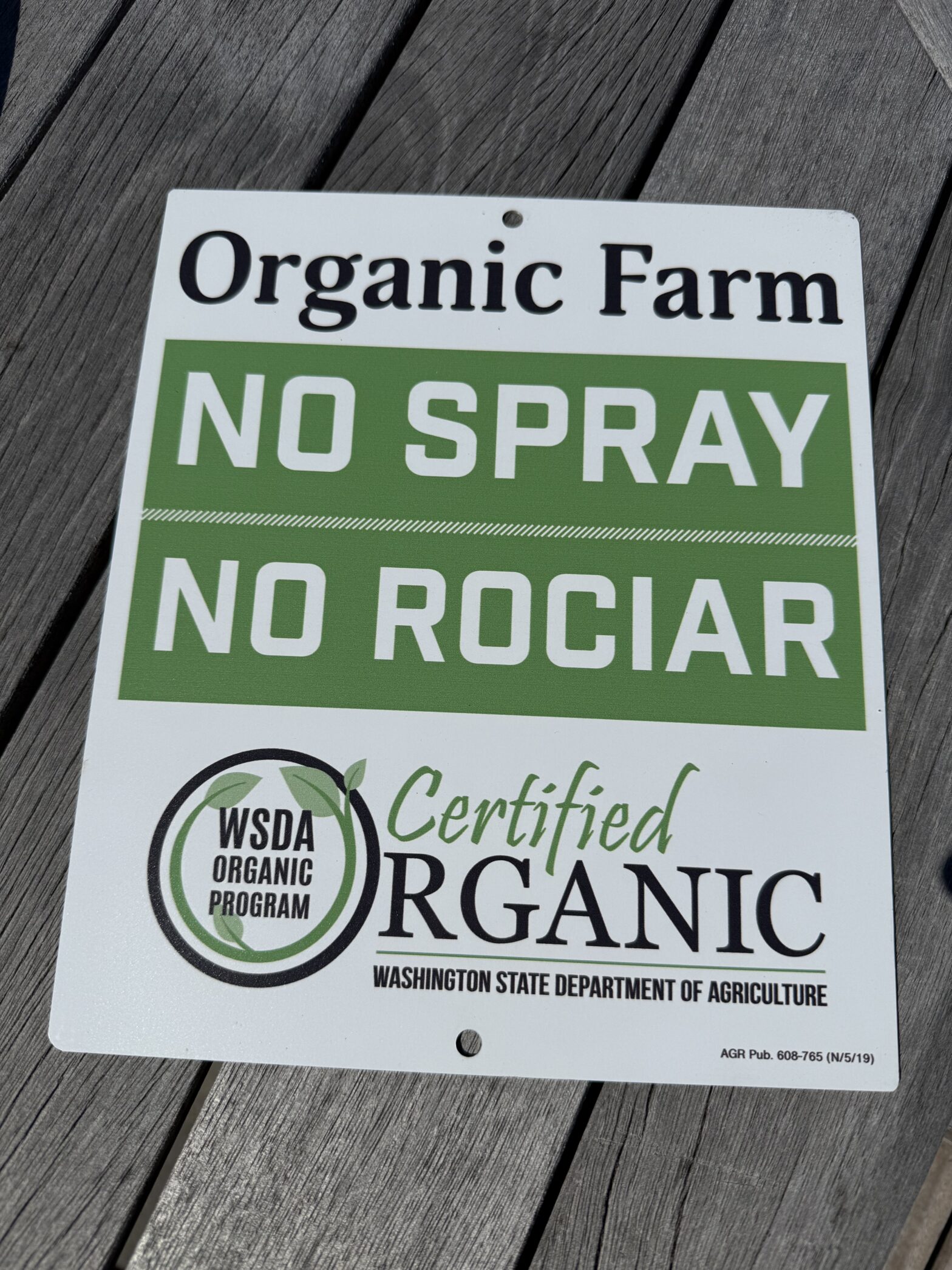
Big news from the farm this week – and it starts with an inspector at our tasting room table. Last Friday…. by Chad
It’s Friday afternoon – the tasting room is open, we’re sitting at the inside table as the WSDA organic inspector goes through our operation and records with a fine tooth comb. Then we walk – boundary inspection and pesticide storage (yes, organic products are still pesticides). After the tour, we sit down for additional questioning and 3 years of record review. At one point Carston and I had a quick moment to ourselves –
“Dude – I don’t know about this?”
Carston’s like “yeah, this is intense.”
There was one moment I was sweating. A record from early 2023, right in the middle of our transition, where a conventional product had slipped into a rec. We never applied it. The proof was a return invoice. Talking through that felt tricky. The inspector was very nice about it.
Then as we get to the end, the inspector says – “Are you ready for your feedback?”
Nervously, I reply – yep.
He proceeds – “Ok, well I don’t have any recommendations or corrections. I’m recommending you for organic certification.”
I have to admit, I kind of felt shocked. Partly because there seemed like no doubt. This stunned sensation, like a bodily pause. Wow, holy cow, that’s so cool. So cool. It took a bit for Carston and I to soak it in. Four years of work – and the answer was yes. It proved we could do it. Almost like another college degree.
We told Jeana as soon as we saw her later that day. She was pretty dang excited.
So what I really thought y’all would be interested in was – what did it take to get our vineyard certified organic?
I’d like to say 1st – there’s simply no way we could have pulled this off without Wilbur Jim and the Wilbur-Ellis Company. Wilbur-Ellis’ organic experience in grapes is what gave us the courage to start farming organically in 2022. This was a big decision. We were basically signing up for more intense / more time management and products that don’t work as well. This meant we would continue to not spray herbicide. You’ll see our weedy vine rows as you drive in. We’d also be spraying more often. “Conventional” fungicides might give us 21 days of control on powdery mildew, where organic products are 5-7 days – depending on the pressure. Since powdery mildew is our biggest pest, followed by botrytis – it’s meant more trips through the vineyard with the tractor. More time, more logistics.
In 2024 I had a moment of – what the hell did we do? As we harvested, the amount of botrytis (think rotten clusters, that can turn sour) we were throwing out was gut wrenching. Leaving crop behind sucks. Having crop go bad on your watch – sucks (even though it was only 15% or less). I just had to suck it up and learn and plan with Wilbur Jim.
In 2025 Wilbur Jim and I stepped up on botrytis management, plus some knowledge from industry experts. Little did we know that around the corner a small spot of another pest would show up – vine mealybug. And remember – farming organically, the tools are much different and usually not superstars. We found a product that smelled like raw garlic and onion – the mealybug ran for the hills – and we haven’t seen them again “yet”.
There are numerous other examples of what it took. The emotional moment at that table – well, it was because it took so much work.
One last thing – I want to be very clear. What we believe in most is regenerative farming. Period. Nutrient dense food and functioning soil ecosystems. You DO NOT have to farm organically to be regenerative. Ok, enough said.
Cheers!


Cheers and Congratulations!
PS…a coincidence- I am proudly wearing my Lagrioth tee😍
Amazing, pretty limited merch that is 🙂
Congratulations Chad and family!
You are doing a very thing.
Thank you!!!!
Fantastic to hear……Congratulations
Thank you!!!
Congratulations. I’m sure this was not an easy decision to go organic when it appears to require so much more effort. So proud of what you and your family are contributing to our valley.
Thanks Karen, you continue to be wind in our sails!!!
Regen
Game changing way to farm.
Amen, amen.
Let me just say…I’m glad you passed the inspection!
Dedication, vision and hard work have paid off…
Thank you!! Yeah, and it continues. More management :), but we believe it’s creating something more resiliant.
Whew! Congratulations! So many hurdles and even though your shins might be black and blue you’re reaching the finish line:)
Thanks Aunt Jill.
Congrats! We are so proud of your accomplishments and hard work.
Thanks Diana. Hope you guys are doing well. Looks like it’s been fun over there this summer following your guys IG.
It is so interesting to read about your farming practices, as a non-farmer. Keep up the good (hard) work!
Thanks!!! You guys rock.