Turns out the barber’s pole worm could be something worth us looking into. by Chad
“Do they have worms?”
Jackson really wants to participate in the agriscience fair, and he really wants to do something with animals. So, we put our heads together as a family and talked through some ideas. Turns out the barber’s pole worm could be something worth us looking into. And it required us getting more on top of our flock’s worm health. We haven’t dewormed in a couple of years. Jackson thought it would be a great project.
First thing to know – worms are normal. Pretty much every sheep, goat, cow and horse carries some. The question isn’t whether they have worms, it’s how many and which kind. The barber’s pole worm is the one to watch. It lives in a sheep’s stomach and drinks her blood. It’s got red and white stripes – like the pole outside an old barbershop. A lot of them can make a ewe weak, sick or worse. It can be a problem in our area, and our irrigated pasture, with its wet grass, is right where the baby worms wait to get eaten.
And if you buy lamb from us – these worms live in the sheep’s stomach, not the meat. They don’t end up in the cuts you take home.
Timing matters too. Our ewes start lambing in mid-January. Right around lambing, a ewe puts everything into her babies and her defenses drop – that’s when the worms take off. So Jackson’s question is pretty simple: can a farmer spot the ewes that need help just by looking at their eyes? A healthy ewe’s inner eyelid is bright pink. When worms are drinking her blood, it goes pale. There’s even a card for it called FAMACHA, with five colors from red to almost white.
Here’s why this matters to us. For years the normal way was to deworm every sheep, every time – and the worms learned to beat the medicine. We don’t blanket-worm our flock. It’s part of farming regeneratively, and we haven’t given our sheep a wormer in over two years. Their numbers are still really low, and we think that points to how we raise them, not to a bottle. Testing first and treating only the ones who need it keeps the wormer working for when we really need it, and we believe it’s better for our flock in the long run.
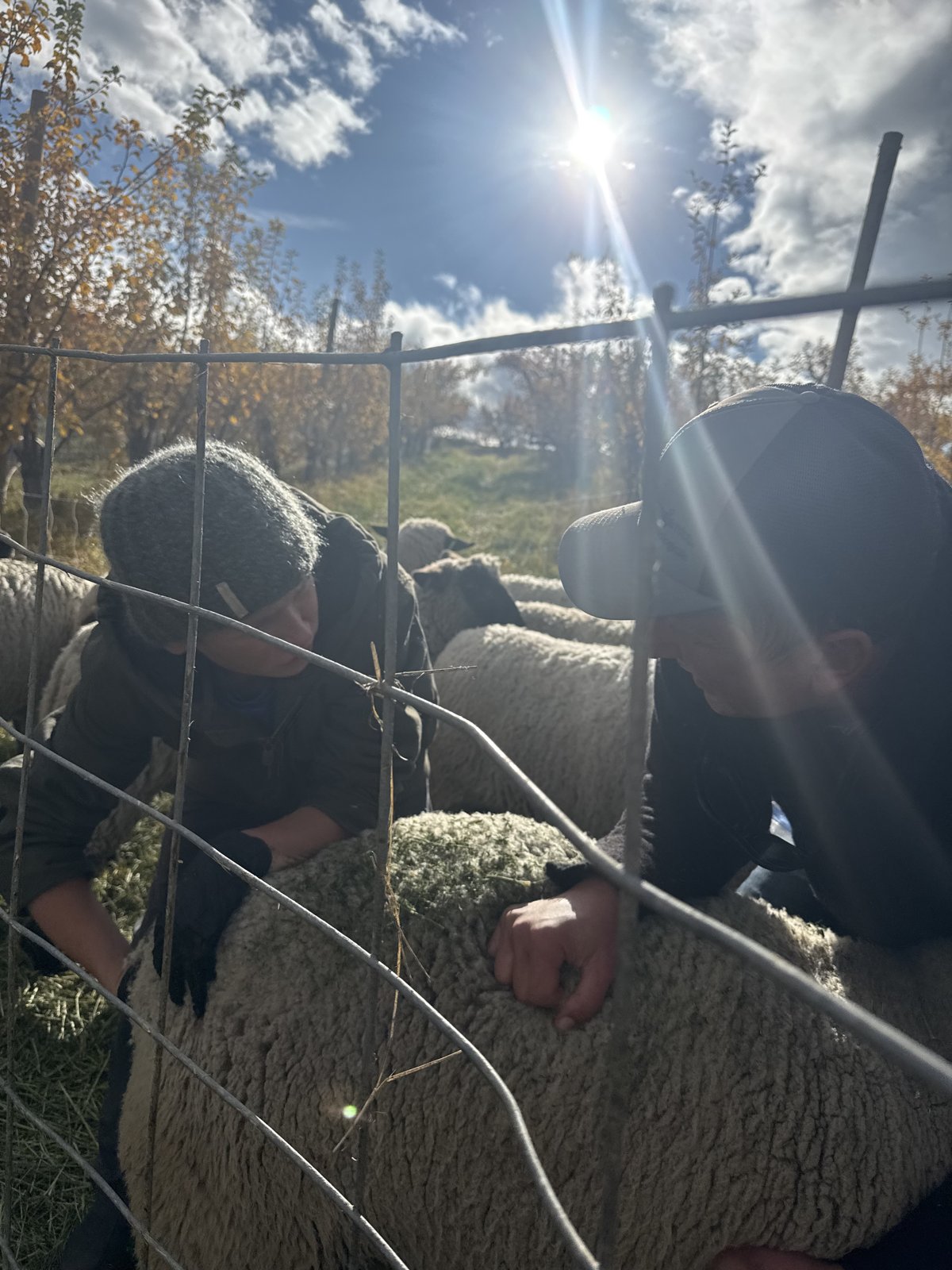
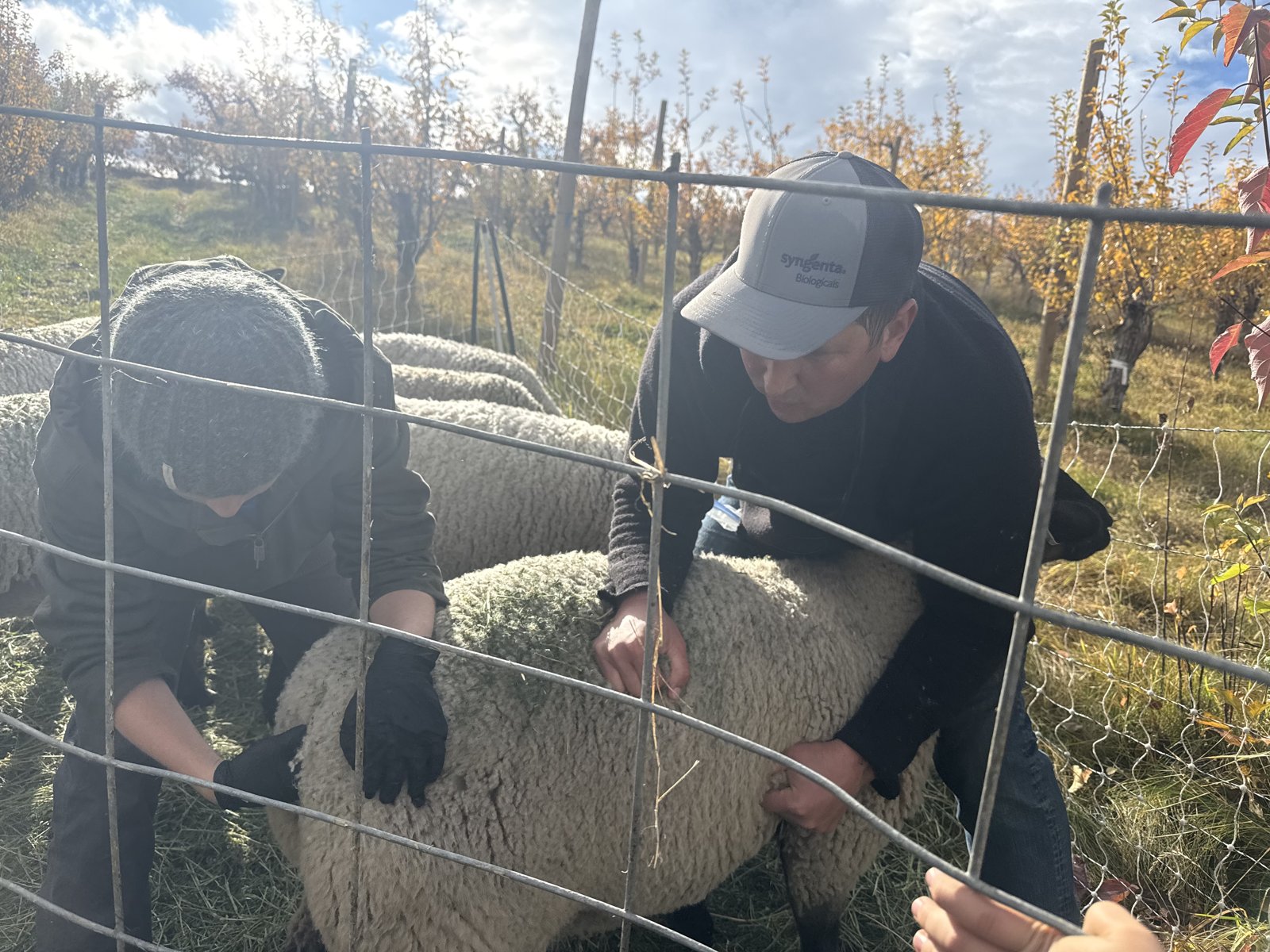
That first sheep, Jackson got his plastic gloves on and got ready to grab poop right from her rectum. He barely hesitated. It’s what I love about Jackson. He seems to know when it’s important, and you just have to do it. Eight sheep later, we had all our samples. Owen helped us hold fence, was our photographer, and really did a nice job making sure we were able to keep the sheep in the smaller pen. The poop samples hung out overnight on Sunday before heading off to Oregon State University. Owen: “Mom, there’s something that I’m just not comfortable with having poop in the fridge.”
On November 17 we shipped the samples to Oregon State’s vet lab, because WSU couldn’t test for this one. The first results came back this week. Five of our eight ewes showed no worm eggs at all. The other three had small counts. The lab is still checking whether any of those eggs are the barber’s pole worm.
Bottom line – our flock is healthy. Five of our eight ewes had no eggs at all, and the highest count was 125, a long way from the thousands you see in sheep that are struggling.
Meet the flock, and their first results
You’ll notice our ewes have numbers, not names. On a working flock, the ear tag is pretty much her name. Our flock is registered with WSDA (the Washington State Department of Agriculture), and the ear tags connect to that registration. The tag is how we keep every record straight – when she lambed, what shots she got, and now what her worm test showed. It’s also how Oregon State knew which bag of manure came from which ewe. Each result below is worm eggs per gram of manure, from Oregon State’s first report.
1068: 25 eggs per gram
0029: no eggs seen (she lost her old tag, 1072, and was retagged this summer)
1118: no eggs seen
1119: no eggs seen
1123: 100 eggs per gram
1128: no eggs seen
0028: 125 eggs per gram, plus a few coccidia (she’s the ewe lamb we kept from 2025)
The secret sheep (yellow tag): no eggs seen. She’s the one ewe in our flock who goes by a name. She came home from Quincy in 2025 with Milo, our Southdown ram, and Carston and I kept her a secret from Jeana for almost three months. Here’s that story.
What we learned this week
Eggs per gram is a count, not a diagnosis. The lab weighs a little manure, floats the eggs to the top and counts them under a microscope. Ours came back in the tens and low hundreds. Sheep in real trouble from worms usually show counts in the thousands. A barber’s pole egg looks like a lot of other worm eggs – so the lab runs a second test to tell which worm it is. That one’s still pending for us.
Testing beats guessing. A ewe can look perfectly fine and still be carrying worms. The only way to know is to check. That’s what lets us treat the few that need it and leave the rest alone.
Doing these projects with the boys really makes me believe they are who can help us improve. They have the ability to work on things we just sometimes can’t get to in the hustle of everything. I’m really grateful for their involvement in The Farm. I’m so grateful for the energy FFA gives our kiddos to be involved in something greater than themselves. FFA is why we’re here.